Peopling the World by Charlotte Sussman
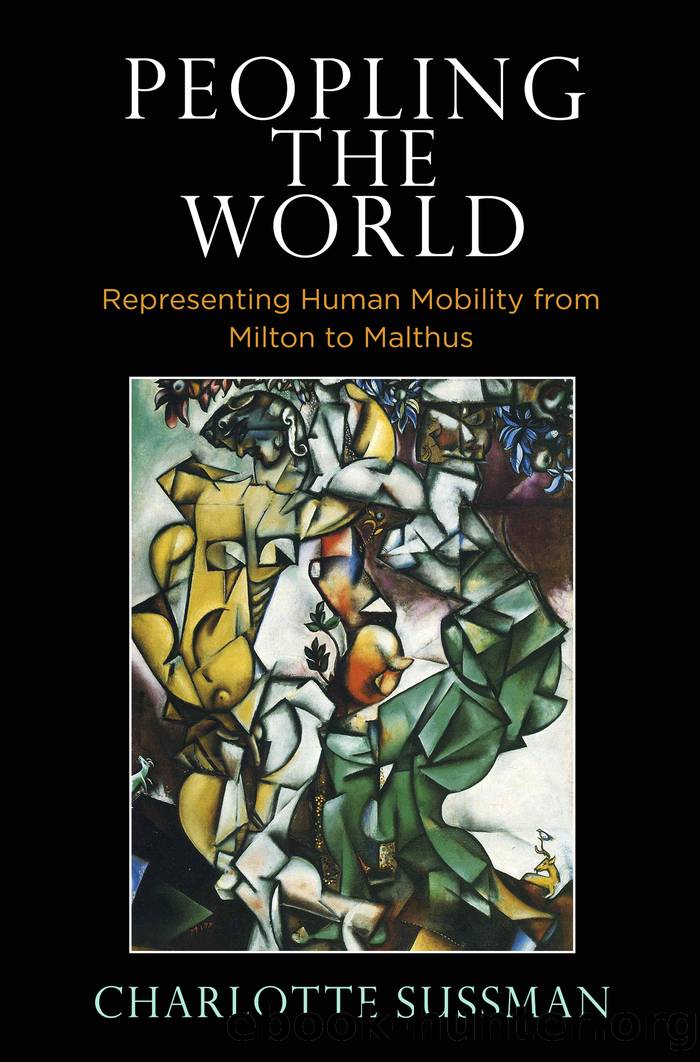
Author:Charlotte Sussman
Language: eng
Format: epub
Publisher: University of Pennsylvania Press, Inc.
Published: 2020-11-15T00:00:00+00:00
CHAPTER 5
The Emptiness at The Heart of Midlothian
Nation, Narration, and Population
After Effie Deans is convicted of infanticide, one of the other characters in The Heart of Midlothian remarks on the seeming hypocrisy of that legal decision. Says Plumdamas, âDo you think our auld enemies of England care a boddle whether we didna kill ane anither, skin and birn, horse and foot, men, women, and bairns, all and sindry, omnes et singulos, as Mr. Crossmyloof says?â1 A reasonable enough assumption, one might think. Yet, Scottâs novel proves Plumdamas wrong about the value of Scottish bodies to England, and thus wrong about the nature of âinternal colonialism.â Indeed, when the fate of Effieâs still-living child is revealed, it neatly refutes Plumdamasâs claim. Rather than dying at his motherâs hand, he has been purchased by âan agent in a horrible trade that carried on between Scotland and America, for supplying the plantations with servants,â that is, with âhuman fleshâ (501). Unwanted, undomesticated, the child is commodified by a system that needs bodies to power colonial production. In this aspect of its plot, The Heart of Midlothian comes close to the vision of one eighteenth-century reformer, who thought Scotland might become âA People-Warren for supplying [the] King with brave soldiers and sailors and the more fertile parts of the kingdom with faithful servants of every description.â2 Scottish bodies acquire the most value in the process of imperial expansion not when they kill each other, but when they become portable units of labor.
Although Effieâs child, called the Whistler, at first avoids being sold to the American colonies through his purchaserâs affection, a colonial destiny eventually overtakes him: the captain of the ship on which he escapes from Knocktarlitie sells him as a servant in Virginia (506). In a way, the Whistler takes on the punishment of banishment his mother has avoided: both the Duke of Argyle and Mrs. Glass expect Effie herself to âgo over to America and marry wellâ (381). But no marriageable tobacco merchant such as âEphraim Buckskinâ (382), willing to absolve him of all guilt, awaits Effieâs child; instead, the Whistler is gradually absorbed into the colonial strife of the American colonies.3 The child does generate a certain amount of pathos and concern in the Butlers, his aunt and uncle, but when Reuben Butler tries to locate him he finds that âthis aid came too late. The young man had headed a conspiracy in which his inhuman master was put to death, and had then fled to the next tribe of wild Indians. He was never more heard of; and it may be presumed that he lived and died after the manner of that savage people, with whom his previous habits had well fitted him to associateâ (506). This information, coming as it does in the last paragraphs of the novel, may seem perfunctory, yet it performs two important functions in the novel. For one thing, in relocating the Whistlerâs violence from the Highlands to America, the novel can be seen as
Download
This site does not store any files on its server. We only index and link to content provided by other sites. Please contact the content providers to delete copyright contents if any and email us, we'll remove relevant links or contents immediately.
The Fine Print (Dreamland Billionaires Book 1) by Lauren Asher(2543)
Fury of Magnus by Graham McNeill(2435)
The Last House on Needless Street by Catriona Ward(2379)
The Rose Code by Kate Quinn(2185)
A Little Life: A Novel by Hanya Yanagihara(2087)
Malibu Rising by Taylor Jenkins Reid(1900)
Luster by Raven Leilani(1888)
The God of the Woods by Liz Moore(1885)
Transcendent Kingdom by Yaa Gyasi(1843)
Moonflower Murders by Anthony Horowitz(1830)
The Lost Book of the White (The Eldest Curses) by Cassandra Clare & Wesley Chu(1676)
This Changes Everything by Unknown(1494)
The Midwife Murders by James Patterson & Richard Dilallo(1470)
The New Wilderness by Diane Cook(1431)
The Lying Life of Adults by Elena Ferrante(1422)
Wandering in Strange Lands by Morgan Jerkins(1399)
Written in the Stars by Alexandria Bellefleur(1388)
Ambition and Desire: The Dangerous Life of Josephine Bonaparte by Kate Williams(1377)
The Lying Life of Adults by Elena Ferrante;(1301)
